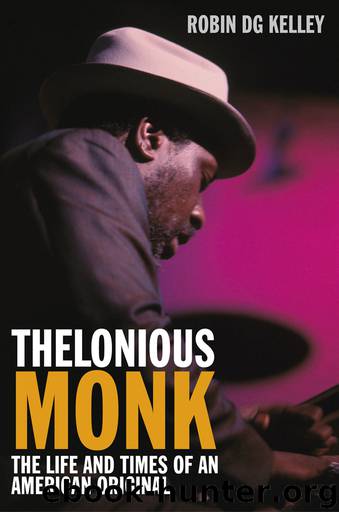
Thelonious Monk by Robin DG Kelley
Author:Robin DG Kelley [Kelley, Robin D.G.]
Language: eng
Format: epub
ISBN: 9781907532764
Publisher: Aurum Press
LISTEN. . . . . . . .68
In an addendum she titled “some thoughts about Thelonious,” she likened him to Bartok, compared his stability and consistency to that of the Rock of Gibraltar, described him as a “one-man renaissance,” insisted on the inevitability of his newfound success, and proclaimed that he “cannot HELP being original! . . . any more than he can help sounding right, whatever he does. . . . and swinging with every breath he takes. . . . !” And he’s a philosopher extraordinaire and a true legend in his own time, whom she placed on par with “Professor Einstein, Charlie Parker, [and] General de Gaulle.”69
Nica may have been Monk’s most passionate champion, but she was not alone. Praise came from all corners of the European and American press. Down Beat critic Peter Welding practically fawned over Monk’s Dream, and Martin Williams published a major essay in the Saturday Review celebrating Monk’s work and long-overdue recognition. Thelonious appreciated Williams’s piece because he put the question of Monk’s technique to rest. He writes, “far from being an inept technician, Monk is a virtuoso—a virtuoso of the specific techniques of jazz, in challengingly original uses of accent, rhythm, meter, time and of musically expressive space, rest, and silence.”70
Monk did not let all the press go to his head. His commitments to his community remained a high priority, even if it meant performing in the House of the Lord. On April 7, Monk and his quartet performed at the Presbyterian Church of the Master in Harlem as the featured artist in their Sunday evening jazz workshop series.71 The Reverend Eugene Callender, a relatively young and dynamic minister, community activist, and consummate jazz lover, had just inaugurated the series in hopes of reaching a younger, hipper generation. Monk had enormous respect for Reverend Callender because of his leadership in the Harlem Neighborhood Associations and the Harlem Youth Opportunities Unlimited (HARYOU), but especially for his ongoing work with the Morningside Community Center.72
Three Sundays later, on April 28, Monk played another benefit—a fundraiser for his son’s school, Cherry Lawn. Held at Staples High School in Westport, Connecticut, the concert drew a full house, attracting students, faculty, parents, as well as jazz fans in the area.73 For Toot, who went by “T.J.” among his classmates, seeing his peers hold his father in such esteem impressed him. The quartet played two outstanding forty-minute sets and an encore. But more than the concert itself, Toot remembered what his father said to him on the way to Westport that afternoon. “I remember getting in the limo with my father to go and during the ride over he said, ‘You’ll be straight after this. . . . Once I do this concert you’re untouchable.’ And I realize now that he knew how this private school thing worked and it was really about who you are. I knew how the white kids operated, the students whose parents donated a few dollars and all of a sudden they didn’t get thrown out, they only got suspended.
Download
This site does not store any files on its server. We only index and link to content provided by other sites. Please contact the content providers to delete copyright contents if any and email us, we'll remove relevant links or contents immediately.
Cecilia; Or, Memoirs of an Heiress — Volume 2 by Fanny Burney(31965)
Cecilia; Or, Memoirs of an Heiress — Volume 3 by Fanny Burney(31947)
Fanny Burney by Claire Harman(26611)
We're Going to Need More Wine by Gabrielle Union(19057)
Plagued by Fire by Paul Hendrickson(17420)
All the Missing Girls by Megan Miranda(16062)
Cat's cradle by Kurt Vonnegut(15379)
For the Love of Europe by Rick Steves(14192)
Bombshells: Glamour Girls of a Lifetime by Sullivan Steve(14086)
Leonardo da Vinci by Walter Isaacson(13347)
4 3 2 1: A Novel by Paul Auster(12409)
The remains of the day by Kazuo Ishiguro(9009)
Adultolescence by Gabbie Hanna(8933)
Note to Self by Connor Franta(7675)
Diary of a Player by Brad Paisley(7592)
Giovanni's Room by James Baldwin(7358)
What Does This Button Do? by Bruce Dickinson(6211)
Ego Is the Enemy by Ryan Holiday(5460)
Born a Crime by Trevor Noah(5386)
